McKenna and Stenberg: Two Top Picks, Two Very Different Careers
Gavin McKenna and Ivar Stenberg sit alone at the top of the public board. The historical comps say they are not the same bet at different sizes — they project to different roles, with different things that could go wrong.
Editorial preview. Canonical research draft:
research/2026_draft_top_two_bet_shapes.md.
If you have the first pick in the 2026 NHL draft, the easy decision is “take one of these two.” The hard part is figuring out what each one actually gives you. Gavin McKenna and Ivar Stenberg sit at the top of every public board, but they are not the same player drawn at different sizes — they project to different roles, with different strengths and different things that could go wrong.
This piece walks through what each prospect looks like as a player, what scouts say about them, and what the careers of similar players have looked like once they got to the NHL.
Gavin McKenna: a high-volume scorer
McKenna spent 2025-26 as a freshman at Penn State, where he put up 51 points in 35 games — fifth in NCAA scoring, the league lead in assists per game, and 32 of those 51 points after the mid-season scouting check. The trajectory was good and the late-season pace was better than the early.
What scouts emphasize:
- NHL Central Scouting flags poise under pressure, hockey IQ, fluid skating, the ability to distribute the puck through traffic, and the kind of game that “drives a line” rather than relying on one.
- NHL.com’s mock-draft language says the same thing a different way: elite offensive driver, vision, playmaking, a player who creates rather than finishes.
- His résumé before college backs it up — a WHL career that produced consistently, plus strong U18s and World Juniors performances at the national level.
The honest concern is physical. McKenna is skilled, but a lot of his game runs through space, patience, and creativity. The NHL takes space away faster than any league he has played in. The question isn’t whether he can score against NHL goaltenders — the comparables below suggest he probably can. It’s whether he can keep winning the puck back at five-on-five against NHL defenders, and whether a coach will keep giving him offensive minutes if the early adjustment is bumpy.
Ivar Stenberg: a two-way center with a star-level ceiling
Stenberg spent 2025-26 in the SHL — Sweden’s top pro league — as an 18-year-old. He finished 11-22-33 in 43 games at 15:11 a night, leading all teenagers in the league in scoring and finishing five points ahead of consensus top-six pick Anton Frondell. NHL Central Scouting calls it one of the best age-18-or-under SHL seasons on record.
What scouts emphasize:
- NHL Central Scouting highlights speed, first-step quickness, balance, hockey IQ, patience with the puck, defensive awareness, board play, and confidence in transition. The two-way label is real.
- Jukka-Pekka Vuorinen, quoted on NHL.com, calls Stenberg exceptionally smart with elite awareness, decision-making, and two-way reliability.
The honest concern shows up in less rosy reports. Tout Sur Le Hockey’s scouting write-up describes a different version of the same player: too much time on the perimeter, too many puck touches away from dangerous ice, limited physical engagement, and skating that is decent rather than elite. The same report still credits the skill — Stenberg generates chances, makes unusual passes, sees lanes others don’t — but raises a real question about whether the style translates against North American NHL pressure.
That tension is the whole Stenberg case. The optimistic reading is a complete two-way center who plays a position that’s hard to fill. The skeptical reading is a perimeter player whose SHL production overstates how much interior ice he actually owns.
Different players, not different sizes of the same player
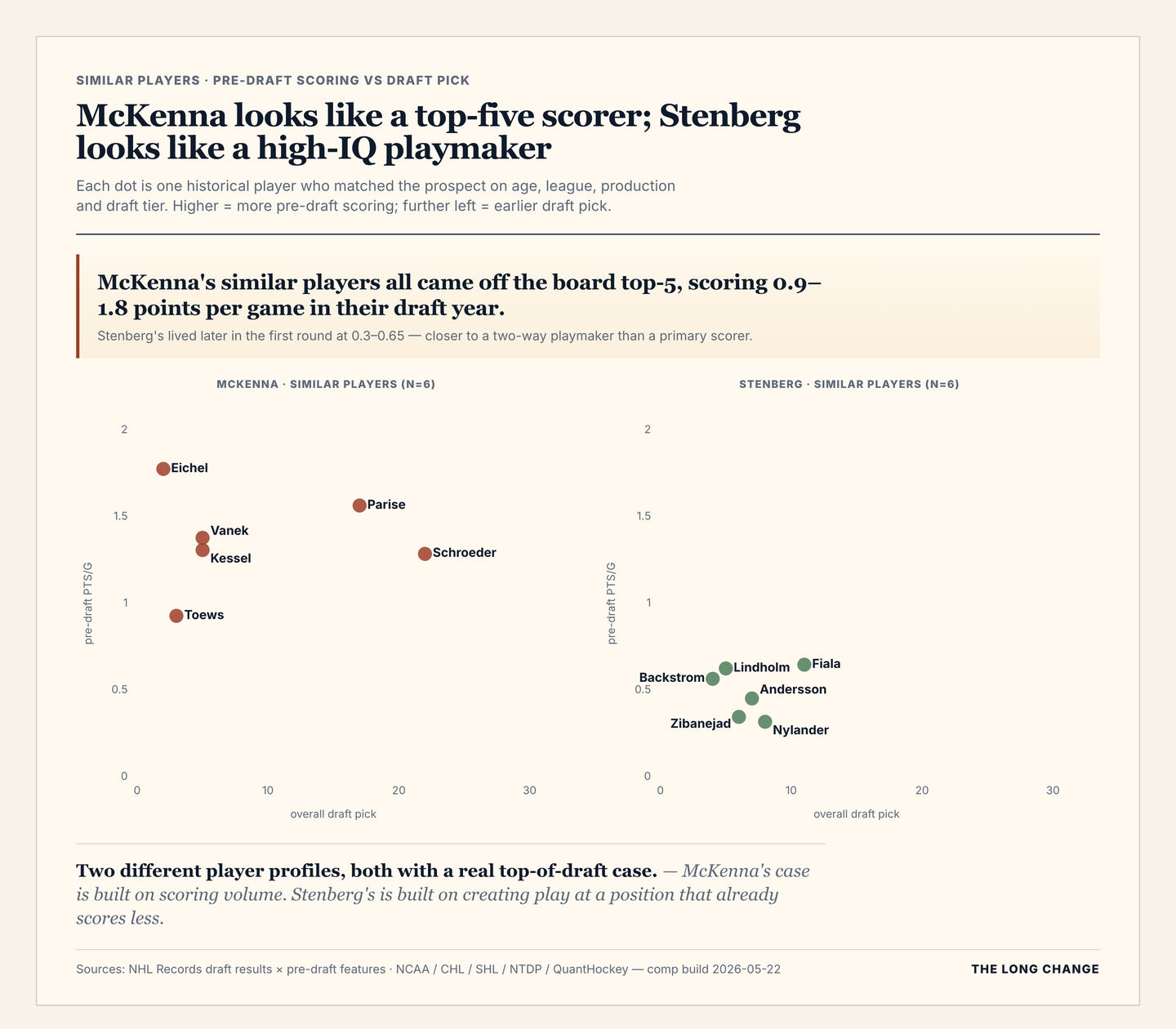
The two side-by-side charts show this clearly. Five of the six historical players most similar to McKenna — by age, league, production, and draft slot — were top-five picks who scored between 0.9 and 1.8 points per game in their draft year: Jack Eichel, Jonathan Toews, Phil Kessel, Thomas Vanek, Zach Parise. The sixth, Jordan Schroeder, fits the production profile but went 22nd overall and never became a full-time NHL scorer — the outlier that shows what the miss looks like.
The six most similar to Stenberg sit in a different place: later in the first round, scoring between 0.3 and 0.65 a game in pro environments where teenage point totals run lower. That’s Nicklas Backstrom, William Nylander, Mika Zibanejad, Elias Lindholm, Kevin Fiala, plus Lias Andersson as the warning case.
Two clusters, two different player profiles. The mistake would be reading Stenberg as “McKenna but with worse numbers.” He’s a different position playing a different game.
What happened to those players, season by season
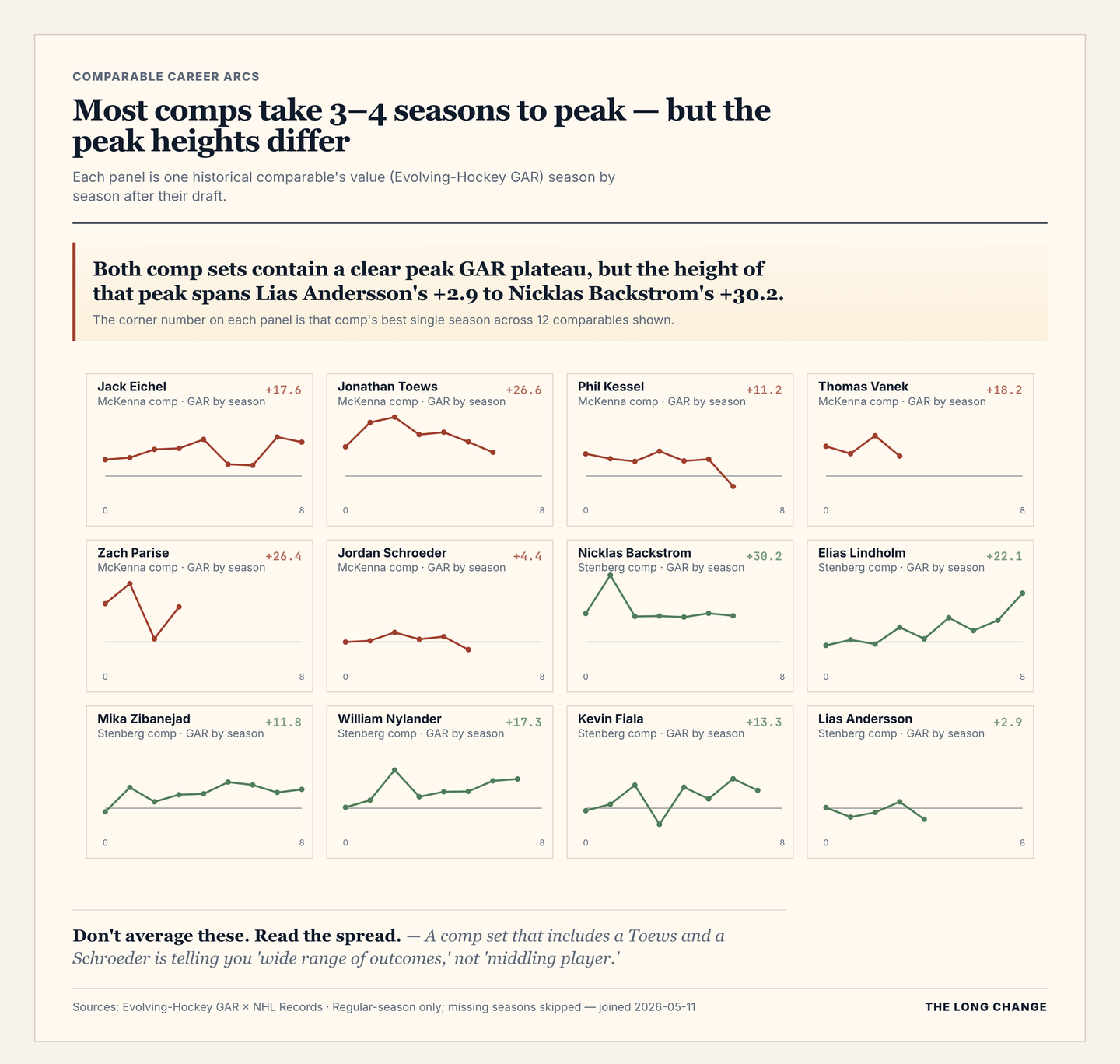
Each panel is one of the twelve comparables, showing their Evolving-Hockey GAR — a single value-above-replacement number — season by season after their draft year. The corner number on each panel is that player’s best single season, and those peaks span a wide range: Andersson’s +2.9 to Backstrom’s +30.2.
A few things worth noticing without averaging anything:
- The peak years arrive late. Eichel and Toews hit their best seasons in years 4-7, not year 1. Backstrom peaked around year 5. Lindholm’s best year came almost a decade after he was drafted.
- Several players took multiple seasons to break positive. Lindholm and Fiala were neutral or below-average for the first few seasons before becoming real top-six contributors. Zibanejad was useful before he was a star.
- Each cohort contains a hit and a miss. Toews and Backstrom landed at the elite end. Schroeder’s trajectory fades from a +4.4 peak to negative in his last season shown; Andersson never established himself at all.
The first-year point totals at the top of each panel are mostly a sideshow — most of the real NHL value showed up later.
Where the careers actually ended up
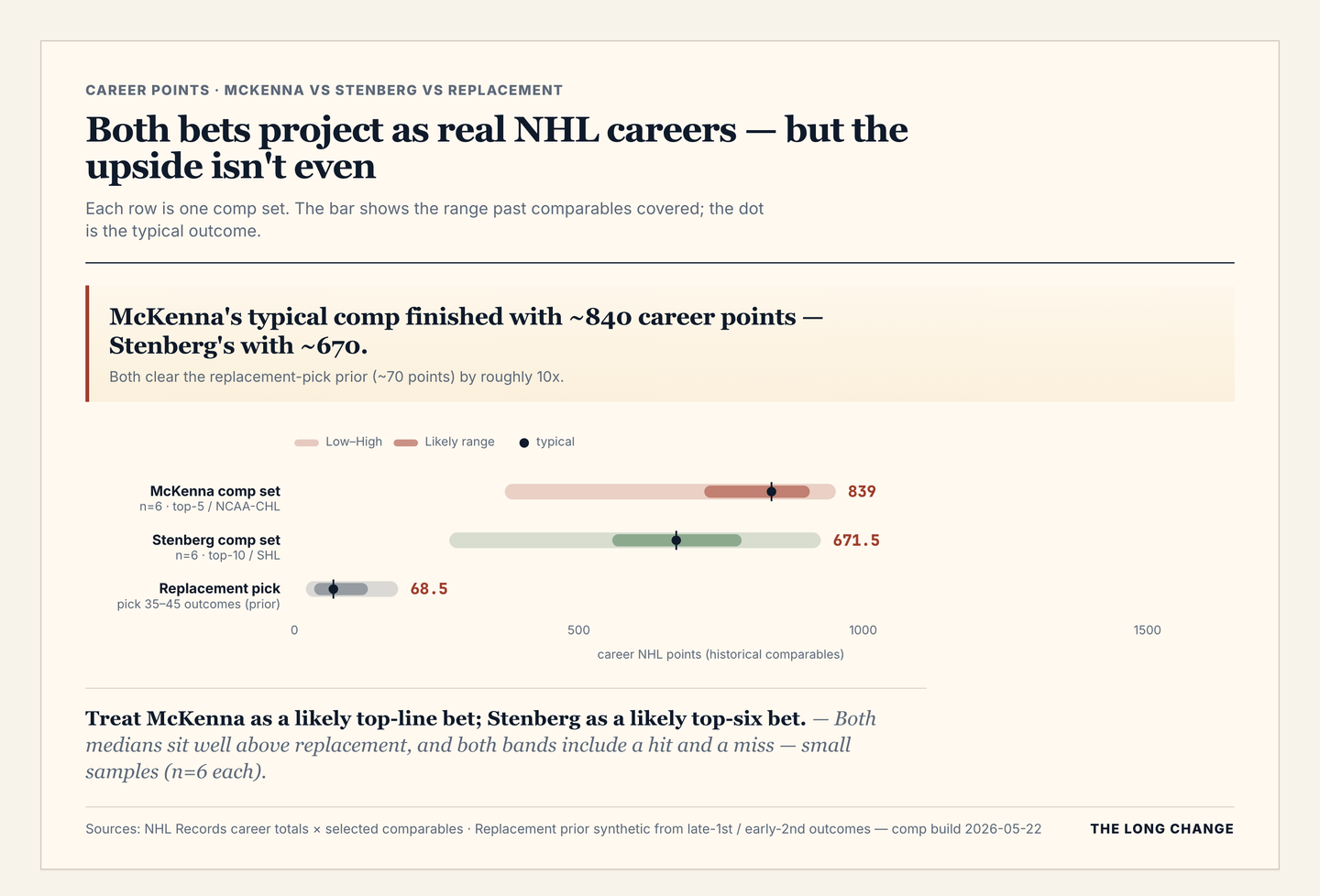
If you take career points from those twelve historical comparables and ask where each cohort landed, the typical player from McKenna’s group finished with around 840 career NHL points. The typical player from Stenberg’s group finished around 670. A typical late-first / early-second-round pick — the kind of player a team can usually find without owning the first pick — finishes around 70.
Both top groups’ typical outcome is roughly 10x a typical replacement-level draft outcome. That’s the middle of the range, not the floor — the wide bars on both rows show real basements too. Schroeder finished with 42 career points and Andersson with 17, both below even the replacement-pick prior. Toews and Backstrom sit at the other end of each cohort.
What to actually do with this
If you’re picking first, the data backs the consensus: McKenna’s case is built on years of scoring dominance across multiple environments, plus a comparable history that mostly became top-line NHL scorers. The risk is concrete and narrow — physical NHL adjustment, ability to own five-on-five ice as a primary scorer — and the scouting consensus is that he clears it more often than not.
If you’re picking second and you wanted Stenberg, argue him as his own case, not as a slightly-worse McKenna. A two-way center who can drive play at both ends is hard to find, and the SHL production at his age is genuinely rare. The skeptical scouting reports give you the failure mode in clear terms: if he stays on the perimeter against NHL forecheck pressure and never wins enough interior touches, the point totals overstate the certainty.
Both teams should expect a real NHL career. The interesting question for each pick — and the one neither the comparable model nor any single scouting report can answer — is whether the specific concern flagged by scouts (McKenna’s pace under pressure, Stenberg’s interior engagement) holds up when the games start counting.
Sources and limits
Current-season production: College Hockey Inc. (NCAA), CHL/WHL statistics, SHL statistics-v2, IIHF tournament statistics. Comparable-player selection and outcomes: NHL Records draft results joined to pre-draft features from NCAA / CHL / SHL / NTDP / QuantHockey (comp build 2026-05-22). Career value trajectories: Evolving-Hockey GAR (regular season; some early-career rows missing in the local join). Scouting profiles: NHL Central Scouting 2026 final-ranking notes, NHL.com Central Scouting features, Tout Sur Le Hockey scouting write-ups.
Six historical players in each comparison group is a small sample. The historical ranges shown above are descriptive of those twelve careers — not a confidence interval about what either prospect will become. Use them to understand what kind of outcome each pick tends to produce, not to set odds.